The Long Climb: Are Festival Stages Actually Launching Debut Authors, or Just Filling Rooms?

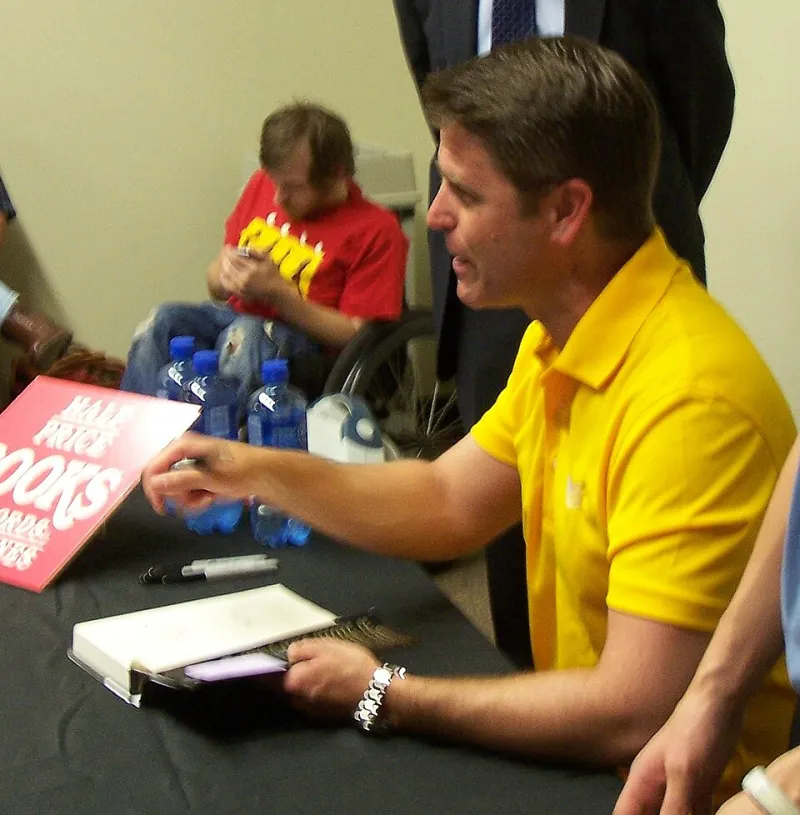
Photo: delegateconnectimages, CC BY 2.0, via Wikimedia Commons
There is a version of the story that gets told at every festival launch party. A debut novelist does an open mic in a pub back room, gets spotted, lands a regional festival panel, then a slot at a bigger festival, then a radio booking, then — somehow — a career. It is a lovely story. It is also, according to almost everyone we spoke to, only occasionally true.
So this is an argument, not a report. Our contention is that the UK festival circuit is very good at building communities and performance confidence, moderately good at building readership, and only rarely the thing that turns a debut into a bestseller. That is not a scandal. It is just worth being honest about, because emerging writers are making real decisions — money, annual leave, childcare — on the assumption that the ladder is steeper than it is.
What organisers actually say when the door is closed
Ask a programmer how they choose debut authors and you get a very practical answer. Budget is small. The venue is a library or a church hall. The audience is loyal but cautious, and cautious audiences buy names they recognise.
The result is a familiar shape. Big festivals put one or two debuts on a themed panel — "New Voices", "First Fiction", "Fresh Ink" — usually early on a Saturday, usually in the smallest room. Regional festivals, by contrast, are markedly braver. One programmer in the East Midlands told us her debut slots consistently out-perform her celebrity memoir slots on audience satisfaction, if not on ticket revenue. She books them anyway.
"We can take a risk on someone unknown because the whole event is a risk," she said. "The big festivals have shareholders to answer to. We have a room and a kettle."
That is not cynicism. It is the structural truth of the circuit: the further you get from a big city and a big sponsor, the more room there is for a first book.
The economics of a single appearance
Here is the unglamorous arithmetic. A well-attended regional event might sell somewhere between fifteen and forty copies through the partner bookshop. Even at a generous royalty, that is not a life-changing sum. Most authors we spoke to were clear-eyed about it.
What a good event does buy you is advocacy. A bookseller who has heard you speak will hand-sell your book for the next eight months. A festival director who liked your panel will mention you to a colleague. A reader who laughed at your answer will post about it. None of that shows up in a sales report, and all of it compounds.
What a bad event buys you is a Tuesday night in a function room in front of nine people, two of whom are your cousins. Everyone who has done the circuit has one of those stories. It does not mean the ladder is broken. It means the ladder is a ladder, and ladders are tedious.
Author testimony: the slow accumulation
A novelist now on her third book described doing nine festivals for her debut — nine events across eighteen months, most of them small. Total sales attributable to the appearances, by her estimate: under two hundred copies.
"And yet," she said, "three of those festivals have invited me back. One of them put me on a panel with a writer who recommended me to a literary agent friend. The book did not break out. The relationships did."
A second writer, a short story author published by a small press, made a different point. Her breakthrough was not a panel at all but the reading group attached to one — a group that met three times before the event, argued about her stories, then turned up en masse. Six of them have since bought everything she has published.
That is the honest shape of the ladder: not a leap from open mic to main stage, but a slow accumulation of rooms full of people who now know your name.
Where the real ladder is
If there is a pathway, it looks closer to this than to the launch-party version:
- Open mic and lit nights — build nerve, build a five-minute set, meet other writers. Sales: negligible.
- Bookshop events — the first real audience of strangers. Sales: modest, but the bookseller becomes your ally.
- Regional festival panel — credibility, a programme credit, photographs you can actually use.
- Repeat bookings — the point at which organisers start calling you rather than the other way round.
- Headline billing — comes, if it comes, around book three or four, or after a prize listing, or after a radio producer hears you say something quotable.
The uncomfortable bit is step one. Open mics are wonderful and almost entirely non-commercial. They build performance muscle and a peer group, and both are genuinely valuable. But nobody in the history of the UK circuit has been discovered at an open mic by a commissioning editor who happened to be in the room. Treat them as training, not as a launch.
A practical checklist for emerging writers
If you are trying to make the leap, this is what the people who programme festivals actually told us to do.
- Go to festivals before you ask to be on one. Programmers remember faces from the audience. It is a small world and it is smaller than you think.
- Get a reading on video. Thirty seconds, good sound, no poetry-voice. Programmers have to justify bookings to committees.
- Approach early, approach regionally. Pitch in January for an autumn slot. Start with the events within ninety minutes of your home, because those are the ones where you can turn up cheaply and be useful.
- Have a workshop ready. A paid workshop often gets a debut author into a festival's orbit faster than a panel slot does, and it pays better.
- Partner with an independent bookshop first. A bookseller who will vouch for you is worth more than a press release.
- Say yes to the small room. The nine-person Tuesday is not a failure; it is how the eighteen-person Thursday starts.
- Send the follow-up. A short, warm email the week after, thanking staff and asking to be considered next year, is rarer than you would imagine.
- Do not measure the first year in copies. Measure it in repeat invitations, bookseller relationships and recordings you can reuse.
So is it building debut authors?
Partly. The circuit does not manufacture breakthroughs, and anyone selling it as a launchpad is overselling. What it does, quietly and at scale, is create a thousand small rooms where a writer can meet thirty readers who will then tell fifteen others.
That is slower than the launch-party story, and much less photogenic. But it is how most writing careers in this country have actually been built — one under-attended Tuesday at a time.