Anyone? Anyone? The Quiet Crisis in the Festival Q&A
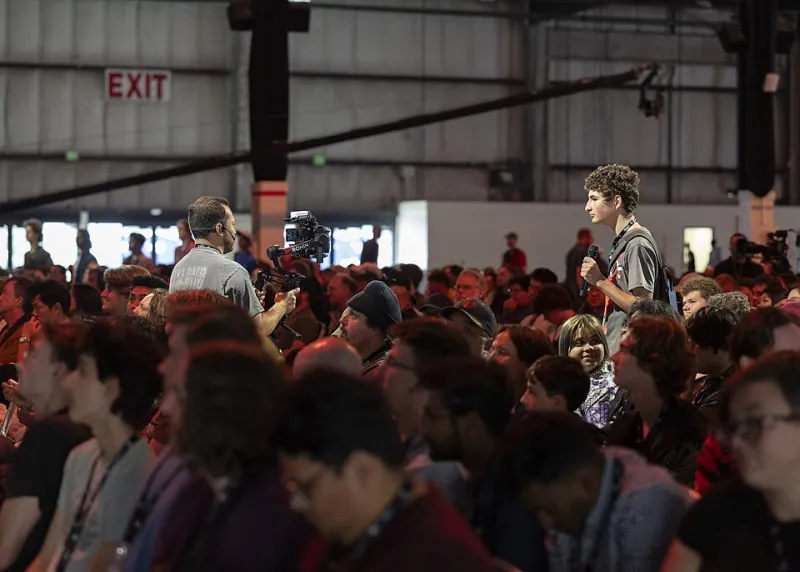
Photo: Tessa Bury, CC BY 4.0, via Wikimedia Commons
There's a particular silence that falls over a festival room when the chair says, brightly, 'we've got about fifteen minutes for questions.' It is not a thoughtful silence. It's the sound of ninety people suddenly becoming extremely interested in the floor.
I've sat in enough Chilterns venues this year to know the pattern. The Q&A is supposed to be the part where the audience gets to talk back. Increasingly it's the part where three people talk and everyone else checks the time.
It's always the same three hands
You know them. There's the retired teacher with the detailed follow-up that's really a lecture. There's the person who wants to argue with the author about a review from 2019. And there's the one who asks where the car park is, which is a fair question and not, strictly speaking, a question for the novelist.
Meanwhile the good questions — the ones that would make the author sit up, the ones from the person in the back row who's been holding a thought since chapter four — never get asked. Because by then the chair is looking at the clock, and the microphone is being wound back in.
Why it's got quieter
Some of this is post-pandemic habit. Several years of watching everything on a screen has left people less practised at speaking in rooms. Some of it is demographic: festival audiences skew older, and older audiences are often beautifully polite and reluctant to take up space.
Some of it is the microphone itself. A roving mic turns a room into a courtroom: one person stands, everyone turns, and the question has to be worth the walk. It's a lot of pressure for a thought you had forty minutes ago and haven't quite finished.
And some of it is us — the programmers. We've got very good at curated content. We book brilliant chairs who can talk to anyone for an hour. Then we tack on twenty minutes at the end, in a room that's already being reset for the next event, and call it audience engagement.
The ritual is the problem, not the audience
'Any questions?' is the least inviting question in the English language. It's a test, and it sounds like one. What it actually asks is: are you the sort of person who asks questions in public? Most people aren't, and no amount of encouragement from the front is going to change that on the day.
So change the question. Hosts who get good Q&As tend to do something slightly different.
Seed the first one. Ask a volunteer, a friend, or the chair themselves to open with a real question. The first hand is the hardest. Once one person has spoken, the room relaxes.
Ask for an argument, not a question. 'What would you push back on?' gets better answers than 'any questions?', because it gives people permission to disagree — which is what half of them wanted to do anyway.
Use cards. Hand them out at the door, collect them at the interval, and have the chair read three. Shy audiences write things they'd never say out loud, and the questions are usually better for it.
Make them talk to each other first. Sixty seconds with the person in the next seat — 'what's one thing you'd ask her?' — and the room has already broken the seal. The hands go up faster afterwards.
Put the mic where people are. Two handheld mics on stands at the aisle ends, plus a chair willing to walk into the room. A roving mic that never roves because the runner is also selling books doesn't help anyone.
Give the audience homework. 'Bring a question about the ending' printed on the ticket sounds twee. It also works, because it gives people a reason to arrive with something prepared.
But don't let it become a free-for-all
The opposite failure is worse: the Q&A that becomes a therapy session, a campaign speech, or a man called Nigel explaining his own book for six minutes. Livelier only works if it's still a conversation.
Which means ground rules, stated cheerfully at the start. One question per person. Thirty seconds, then the chair steps in. No speeches. If the author says 'pass', they pass. And if someone's question is a rant wearing a question mark, the chair's job is to take it, thank them, and move on — not to referee a debate nobody signed up for.
It also means protecting the author. Writers are not obliged to be cornered about their divorce, their politics, or the thing a reviewer said in 2019. A good chair can turn a hostile question into a useful one in about four seconds, and the best ones do it without making anyone feel small.
What a good one feels like
The best audience conversation I've seen on the circuit this year wasn't in the room at all. It started there — a question about an ambiguous ending that the author answered with a shrug and a grin — and then carried on in the foyer, in the signing queue, and in the pub across the road, where six strangers kept arguing about it until the landlord put the chairs up.
That's the thing about the Q&A. It isn't really a fifteen-minute slot at the end of an event. It's the bit where a festival becomes a conversation, and the conversation carries on without you. Programmers should budget for it properly, chairs should be briefed on it, and audiences should turn up with one question each and no fear at all.
The mic is there. Use it.