The People in the Hi-Vis: Who Actually Runs a Chilterns Book Festival?
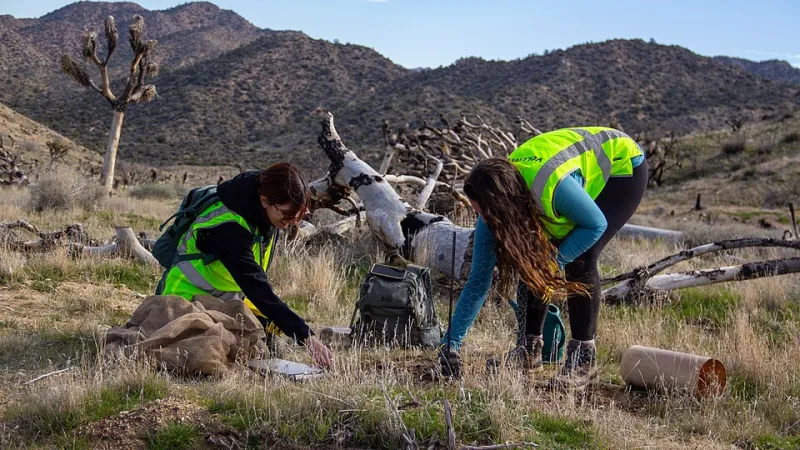
Photo: Joshua Tree National Park, Public domain, via Wikimedia Commons
On a damp Saturday in late October, the first volunteers arrive at a village hall near Chesham well before the audience does. One is carrying a box of lanyards. Another is trying to work out which extension lead belongs to the portable card reader. By half past eight, the tea urn is on, the bookshop table is squared away and someone is putting a handwritten sign on the disabled loo because the usual one has gone missing. The first author is not due for another hour.
This is the bit of a literary festival that rarely makes the programme. The Chilterns circuit has plenty of visible faces — the novelists, the historians, the broadcasters, the local poets with a devoted following. But behind every upstairs-room event, church-hall panel and festival marquee is an unpaid workforce doing the quiet, repetitive, essential work. As the 2026 season draws to a close, it is worth asking who those people are, why they turn up, and whether the model can survive the next few years.
Not a faceless army
Festival volunteers are often described as if they were a single bloc. They are not. There are the stewards who check tickets and point people towards the loo. There are box-office helpers who troubleshoot lost confirmations and print last-minute replacements. There are green-room runners making sure an author has water, a quiet corner and someone to tell them the room is full. There are bookshop volunteers, refreshment volunteers, tech volunteers, first-aid volunteers and the person who ends up holding the bucket for the collection because the card machine has dropped offline again.
Some are retired and have been doing it for a decade. Some are students building something to put on a CV. Some are remote workers who want a weekend that is not spent staring at a screen. Some are parents who can only manage one shift. Some are committed festival-goers who realised the event would not happen without them. The common thread is not a surplus of free time. It is a willingness to spend some of it on something local, bookish and finite.
The rewards are not usually financial. A free ticket is common, though many volunteers barely see a full event. Expenses may cover parking or a bus fare, and lunch might be a sandwich in the green room. Some festivals offer a book token or a small thank-you. But the real currency is social: belonging, local pride, a behind-the-scenes view and the satisfaction of making a room feel welcoming.
The rota is the real programme
Talk to organisers and the conversation quickly turns to logistics. A festival programme is a public document; a volunteer rota is an internal thriller. It has gaps, last-minute swaps and a cast of people who have agreed to do more than they intended. Behind it sits a volunteer coordinator — sometimes paid, often not — who spends weeks matching skills, availability and boundaries.
There are also the unglamorous compliance bits that audiences never see: safeguarding checks, first-aid cover, fire procedures, manual-handling common sense and clear instructions for what to do if an author is late, unwell or simply cannot find the venue. None of this is optional. A festival that gets it wrong does not just have a bad day; it has a serious problem.
In 2026, the recruitment side feels harder. Organisers across the Chilterns describe the same pattern: a dependable core of long-serving volunteers, a steady trickle of new faces, and a growing difficulty filling weekday and evening shifts. Cost-of-living pressures have made unpaid time feel more expensive. Rural bus cuts and unreliable trains make some venues awkward to reach. Younger volunteers often want shorter, clearly defined shifts rather than a whole weekend. And there is more competition for attention from other charities, community groups and cultural events.
No one keeps a Chilterns-wide census of festival volunteers, which is part of the problem. The sector talks endlessly about audience data, ticket yield and author fees, but the unpaid workforce is often measured in anecdotes. That makes it easy to miss the quiet crisis until a festival is short-staffed and cutting capacity.
What volunteers actually get
It would be patronising to frame volunteering as charity. Many people do it because it is genuinely enjoyable. You meet authors. You see how the event works. You learn to handle a difficult queue, a lost ticket or a last-minute change of room. You get a reference, a skill, a social circle or simply a Saturday that feels useful.
But there is a line between a fair exchange and volunteer creep. When paid roles disappear and the gaps are filled by goodwill, the model starts to rely on people who cannot say no. The answer is not to romanticise exhaustion. It is to make volunteering easier: clear role descriptions, realistic shift lengths, expenses paid promptly, food and water provided, breaks protected, quiet spaces available and a named person to ask for help.
Festivals that do this well tend to keep people. Festivals that treat volunteers as a last-minute resource tend to lose them. The difference is rarely money alone. It is whether someone feels useful rather than used.
The cost of free
The economics of a small literary festival are tight. Ticket income has to cover author fees, venue hire, insurance, tech, marketing and the hundred small costs that appear in the final week. Volunteers help square that circle. They are not a nice extra; they are infrastructure.
But infrastructure needs maintenance. If the Chilterns circuit wants a volunteer economy in 2027 and beyond, it will need to invest in it: a budget line for volunteer coordination, proper expenses, training and recognition that goes beyond a shout-out in the closing speech. It will also need to think about access — not everyone can stand for four hours, drive to a village hall or give up a whole weekend.
Micro-volunteering, buddy shifts, year-round community building and clearer routes from first-time helper to trusted steward are not radical ideas. They are practical ones. The festival circuit talks endlessly about authors and audiences. The real story is the people in the hi-vis, holding the clipboard, checking the room and making sure the day happens at all. Treat them as decoration and the model will falter. Treat them as the engine and it might just keep running.